
| Exam Code | AI-901 |
| Exam Name | Microsoft Azure AI Fundamentals (Updated Version) |
| Vendor | Microsoft |
| Total Questions | 125 |
| Last Updated | 15-Nov, 2026 |
- Latest & Verified Questions
- Detailed Explanations
- Regular Updates
- Full-Length Practice Tests
- Boost Your Exam Confidence
PDF Study Materials
Downloadable guides and resources
Practice Tests
Full-length tests with real exam experience
Progress Tracking
Monitor your performance and improvement
Study Anywhere
Access on desktop, tablet, and mobile
Free AI-901 Practice Questions
Explore 11 free practice questions for the Microsoft AI-901 exam and review the answers and explanations to support your preparation.
-
Question 1
Single answerYou are developing an application that analyzes voicemail recordings by using Azure Content Understanding in Foundry Tools. You need to extract a transcript and structured information from the recordings. Which type of analyzer should you use?
-
Option A:Correct
document analyzer
-
Option B:Correct
video analyzer
-
Option C:Correct
audio analyzer
-
Option D:Correct
image analyzer
Show Answer & Explanation Hide Answer & Explanation
Correct Answer: C
Explanation
Voicemail recordings are audio content. Azure Content Understanding analyzers define what type of content to process, including documents, images, audio, or video, and what elements to extract, including transcripts and structured fields. Microsoft’s custom analyzer documentation also shows an audio example based on prebuilt-audio for processing customer support call recordings, which is the same content type as voicemail recordings. Therefore, to extract a transcript and structured information from voicemail recordings, you should use an audio analyzer.
-
-
Question 2
Multiple answersWhat are two purposes of instructions when prompting a generative AI model? Each correct answer presents part of the solution. NOTE: Each correct selection is worth one point.
-
Option A:Correct
defines constraints on the model's responses
-
Option B:Correct
defines the agent's role and behavior
-
Option C:Correct
defines the Azure region where inference occurs
-
Option D:Correct
selects which model to use
-
Option E:Correct
defines the tokens per minute (TPM) allocation for the model
Show Answer & Explanation Hide Answer & Explanation
Correct Answer: A, B
Explanation
Microsoft Foundry Agent Service documentation states that instructions define goals, constraints, and behavior for an agent. Therefore, instructions are used to guide how the generative AI model or agent should respond and behave. Option A is correct because instructions can define constraints the model must follow. Option B is correct because instructions can define the agent’s role and behavior. Options C, D, and E are incorrect because Azure region, model selection, and TPM allocation are configuration or deployment/resource settings, not purposes of prompt instructions.
-
-
Question 3
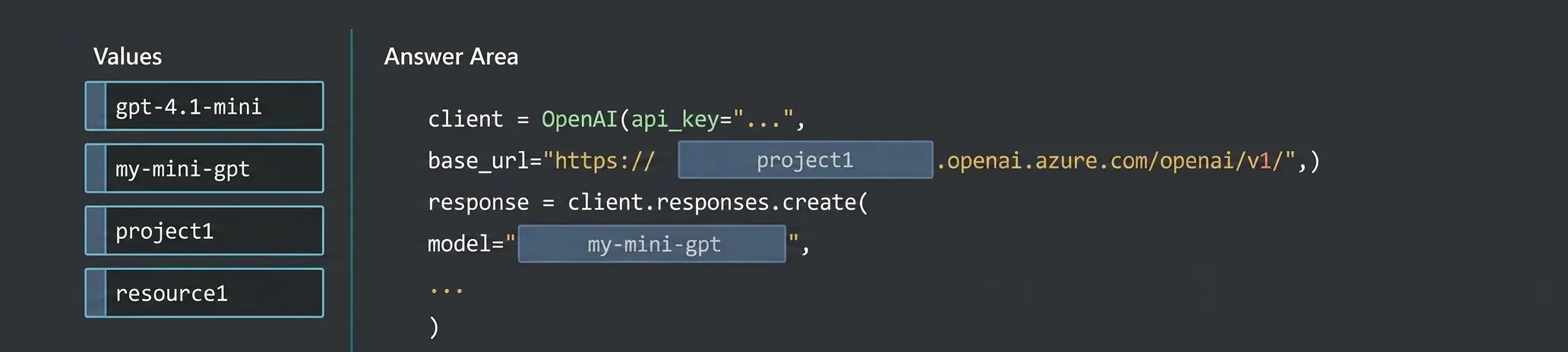
Drag & DropTo Resource1, you deploy a gpt-4.1-mini model by using a model deployment named my-mini-gpt. You need to connect to my-mini-gpt from an application. How should you complete the Python code? To answer, drag the appropriate values to the correct targets. Each value may be used once, more than once, or not at all. NOTE: Each correct selection is worth one point.
Show Answer & Explanation Hide Answer & Explanation
Correct Answer
Explanation
client = OpenAI( api_key="...", base_url="https://resource1.openai.azure.com/openai/v1/", ) response = client.responses.create( model="my-mini-gpt", ... ) For Azure OpenAI in Microsoft Foundry, the base_url uses the Azure OpenAI resource name in the endpoint format: https://<resource-name>.openai.azure.com/openai/v1/ In the question, the Azure OpenAI resource is named Resource1, so the first blank must be resource1. Microsoft documentation for Azure OpenAI v1 endpoints confirms that the endpoint must use the ...openai.azure.com/openai/v1/ path. For the model parameter, Azure OpenAI requires the deployment name, not the underlying model name. Microsoft states that Azure OpenAI always requires the deployment name when calling APIs, even when the parameter is named model. The deployed model is gpt-4.1-mini, but the deployment name is my-mini-gpt. Therefore, the second blank must be: model="my-mini-gpt" So the correct selections are: base_url blank = resource1 model blank = my-mini-gpt
-
Question 4
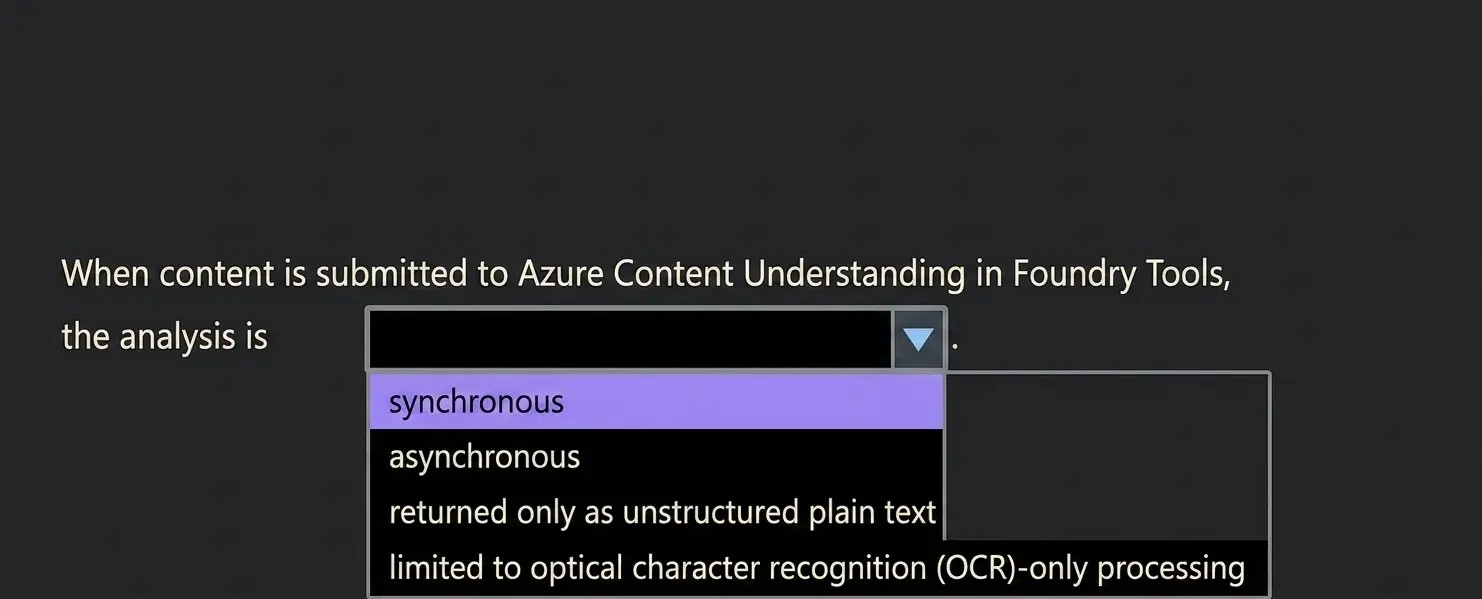
Drag & DropHOTSPOT Select the answer that correctly completes the sentence.
Show Answer & Explanation Hide Answer & Explanation
Correct Answer
Explanation
When content is submitted to Azure Content Understanding in Foundry Tools, the analysis is asynchronous. This means the service does not return results immediately within the same HTTP request. Instead, it uses the standard Azure long-running operation (LRO) pattern — you call begin_analyze() to submit the content, which immediately returns a poller object, and then call poller.result() to wait for processing to complete and retrieve the structured extraction results. Why the other options are wrong: Synchronous is incorrect — the analysis pipeline involves multiple AI steps (OCR, speech transcription, schema mapping) that take time; a blocking synchronous call is not supported. Returned only as unstructured plain text is incorrect — Azure Content Understanding returns richly structured JSON output with named fields mapped to your defined schema, not plain unstructured text. Limited to OCR-only processing is incorrect — Content Understanding goes far beyond OCR; it supports document, audio, image, and video analyzers, and performs semantic field extraction using AI, not just character recognition. This asynchronous design is consistent across all Azure AI services that perform complex, multi-step content processing.
-
Question 5
Single answerYou have a Microsoft Foundry project that contains an agent named Agent1. You need to ensure that Agent1 always calls an Azure function when the agent responds to user input. To what should you set tool_choice for Agent1?
-
Option A:Correct
auto
-
Option B:Correct
none
-
Option C:Correct
required
Show Answer & Explanation Hide Answer & Explanation
Correct Answer: C
Explanation
Microsoft’s Foundry Agent Service documentation states that tool_choice provides deterministic control over tool calling: auto means the model decides whether to call tools. required means the model must call one or more tools. none means the model does not call tools. Therefore: A . auto = Incorrect, because the model may or may not call the Azure function. B . none = Incorrect, because this prevents tool/function calls. C . required = Correct, because it forces the agent to call a tool. The Azure OpenAI function-calling documentation also confirms that tool_choice="auto" lets the model decide whether to call a function, while tool_choice="none" forces a user-facing response without a tool call.
-
-
Question 6
Single answerWhich action can be performed by using the Azure Vision in Foundry Tools service?
-
Option A:Correct
identifying breeds of animals in live video streams
-
Option B:Correct
extracting data from handwritten letters
-
Option C:Correct
extracting key phrases from documents
-
Option D:Correct
Show Answer & Explanation Hide Answer & Explanation
Correct Answer: B
Explanation
Azure Vision in Foundry Tools supports OCR capabilities for reading printed and handwritten text from images and documents. Microsoft documentation states that OCR extracts text from images and documents, including handwritten text.
Therefore, extracting data from handwritten letters is the action that can be performed by using Azure Vision in Foundry Tools.
-
-
Question 7
Single answerVerifying that machine learning models do NOT show racial or gender bias is an example of which Microsoft responsible AI principle?
-
Option A:Correct
Safety
-
Option B:Correct
Privacy and security
-
Option C:Correct
Reliability
-
Option D:Correct
Show Answer & Explanation Hide Answer & Explanation
Correct Answer: D
Explanation
Verifying that machine learning models do not show racial or gender bias is an example of the Microsoft responsible AI principle of fairness.
Fairness means AI systems should treat people equitably and avoid unfair bias across demographic groups such as race, gender, age, or other protected characteristics.
Why the other options are incorrect:
A. Safety focuses on avoiding harm and operating safely.
B. Privacy and security focuses on protecting data and access.
C. Reliability focuses on consistent and dependable operation.
D. Fairness directly addresses bias and equitable treatment.
-
-
Question 8
Single answerYou have a Microsoft Foundry project that has a generative AI model deployment.
You need to ensure that responses generated by the model minimize costs and remain within a defined length.
Which parameter should you configure?
-
Option A:Correct
Temperature
-
Option B:Correct
Max Completion Tokens
-
Option C:Correct
Top P
-
Option D:Correct
Show Answer & Explanation Hide Answer & Explanation
Correct Answer: B
Explanation
To minimize cost and keep generated responses within a defined length, configure Max Completion Tokens.
Microsoft’s Azure OpenAI / Foundry API reference defines max_completion_tokens as an upper bound for the number of tokens that can be generated for a completion. Because generated tokens contribute to usage and response length, limiting completion tokens helps control both output length and cost.
Temperature and Top P control randomness or sampling behavior, not maximum response length. Model version settings do not directly define the generated response length.
-
-
Question 9
Single answerYou are using the Azure Speech SDK to develop a Python application that supports real-time spoken conversations.
Which Azure speech class should you use to configure the connection to the Azure Speech service?
-
Option A:Correct
AudioConfig
-
Option B:Correct
SpeechSynthesizer
-
Option C:Correct
Show Answer & Explanation Hide Answer & Explanation
Correct Answer: C
-
-
Question 10
Single answerYou need to build an AI solution that responds to user queries with detailed written explanations.
Which type of AI model should you use?
-
Option A:Correct
a speech recognition model
-
Option B:Correct
an embedding model
-
Option C:Correct
an image generation model
-
Option D:Correct
Show Answer & Explanation Hide Answer & Explanation
Correct Answer: D
-
-
Question 11
Single answerYou have a Microsoft Foundry project that contains an agent named Agent1.
You need to ensure that Agent1 always calls an Azure function when the agent responds to user input.
To what should you set tool_choice for Agent1?
-
Option A:Correct
auto
-
Option B:Correct
-
Option C: requiredCorrect
Show Answer & Explanation Hide Answer & Explanation
Correct Answer: C
Explanation
Microsoft’s Foundry Agent Service documentation states that tool_choice provides deterministic control over tool calling:
auto means the model decides whether to call tools.
required means the model must call one or more tools.
none means the model does not call tools.
Therefore:
A. auto = Incorrect, because the model may or may not call the Azure function.
B. none = Incorrect, because this prevents tool/function calls.
C. required = Correct, because it forces the agent to call a tool.
The Azure OpenAI function-calling documentation also confirms that tool_choice= " auto " lets the model decide whether to call a function, while tool_choice= " none " forces a user-facing response without a tool call.
-