
| Exam Code | AB-731 |
| Exam Name | AI Transformation Leader (beta) |
| Vendor | Microsoft |
| Total Questions | 77 |
| Last Updated | 15-Nov, 2026 |
- Latest & Verified Questions
- Detailed Explanations
- Regular Updates
- Full-Length Practice Tests
- Boost Your Exam Confidence
PDF Study Materials
Downloadable guides and resources
Practice Tests
Full-length tests with real exam experience
Progress Tracking
Monitor your performance and improvement
Study Anywhere
Access on desktop, tablet, and mobile
Free AB-731 Practice Questions
Explore 10 free practice questions for the Microsoft AB-731 exam and review the answers and explanations to support your preparation.
-
Question 1
Single answerYou have a historical dataset that contains 1,000 records. You need an AI solution that can analyze the data to identify patterns and predict future outcomes. What should you include in the solution?
-
Option A:Correct
Microsoft Foundry
-
Option B:Correct
Azure Document Intelligence in Foundry Tools
-
Option C:Correct
Azure Machine Learning
-
Option D:Correct
Azure Content Understanding in Foundry Tools
Show Answer & Explanation Hide Answer & Explanation
Correct Answer: C
Explanation
The requirement describes a predictive analytics / machine learning scenario: using historical data to learn patterns and then predict future outcomes. The Microsoft service that directly supports the end-to-end machine learning lifecycle—data preparation, model training, evaluation, deployment, and MLOps—is Azure Machine Learning, which is why C is the best choice. Azure Machine Learning is explicitly designed to help data scientists and engineers train and deploy models and manage the ML project lifecycle, making it the right fit for building a predictive model from your dataset. The other options focus on different problem classes: Azure Document Intelligence is for extracting structured data from documents (OCR, key-value pairs, tables), not for general predictive modeling. Azure Content Understanding is for deriving structured insights from multimodal content (documents, images, audio, video) into a user-defined schema; it’s not the primary service for training predictive models from a tabular historical dataset. Microsoft Foundry is a broader platform for building AI apps/agents and orchestrating models/tools, but the specific need here is classical ML training and prediction—handled most directly by Azure Machine Learning.
-
-
Question 2
Multiple answersYour company uses a non-reasoning generative AI model to create textual content. You discover that the model’s responses are inconsistent and do NOT meet expectations. You need to improve the prompts. What should you do? More than one answer choice may achieve the goal. Select the BEST answer.
-
Option A:Correct
Provide the prompts with extensive examples of the expected output.
-
Option B:Correct
Add the context, sources, and expectations to the prompts.
-
Option C:Correct
Use technical terms in the prompts to enhance AI comprehension.
-
Option D:Correct
Add only a single concise requirement to the prompts.
Show Answer & Explanation Hide Answer & Explanation
Correct Answer: A, B
Explanation
When a non-reasoning generative AI model produces inconsistent outputs, the most reliable improvement is to make the prompt more specific, constrained, and demonstrative of what “good” looks like. A is correct because adding high-quality examples is a form of few-shot prompting. Examples act like “training wheels” at inference time: they show the model the desired structure, tone, level of detail, formatting rules, and boundaries. This reduces ambiguity and variance, especially for tasks like marketing copy, summaries, policy text, or customer replies. The more your examples resemble real target outputs (including edge cases), the more consistent the model’s completions become. B is correct because adding context, relevant source material, and explicit expectations narrows the model’s degrees of freedom. Including the intended audience, purpose, constraints (length, voice, banned claims), and trusted reference content (approved facts, product specs, policy excerpts) helps
the model stay aligned and reduces hallucinations and off-brand language. This is also where you specify acceptance criteria such as “must include 3 bullet points,” “use UK English,” or “cite only provided text.” C is not best: technical jargon can confuse or bias output if it’s not aligned to the task; clarity beats jargon. D is not best: a single concise requirement is usually under-specified and often increases variability. -
-
Question 3
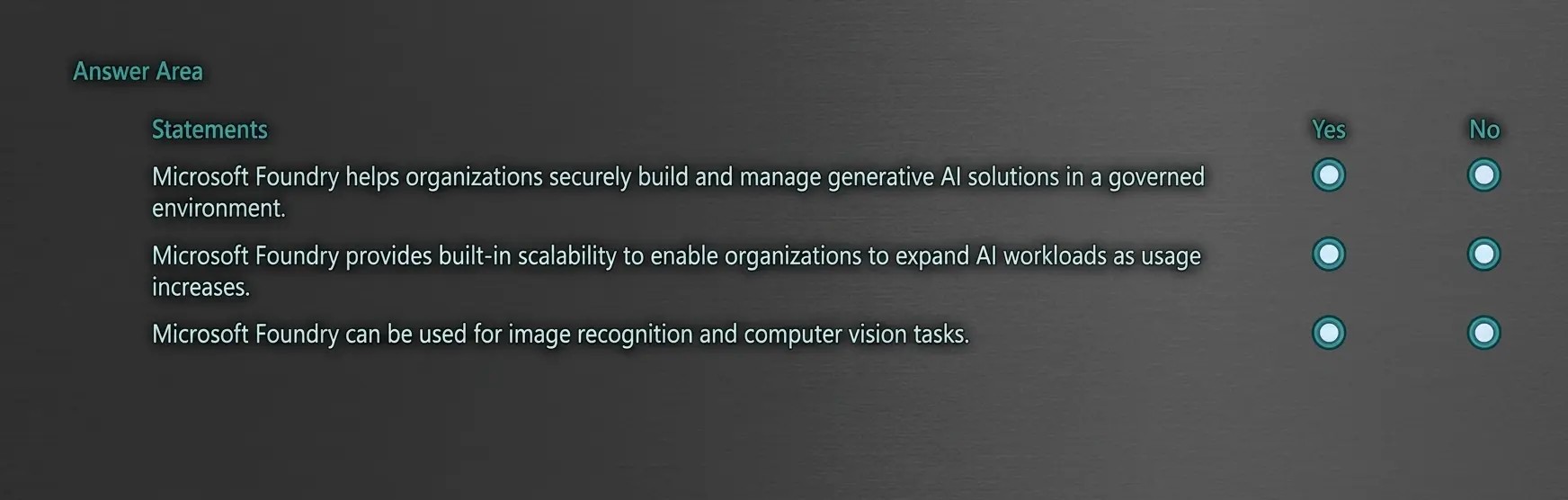
Drag & DropFor each of the following statements, select Yes if the statement is true. Otherwise, select No. NOTE: Each correct selection is worth one point.
Show Answer & Explanation Hide Answer & Explanation
Correct Answer
Explanation
Microsoft Foundry is positioned as a unified platform experience for building, optimizing, and governing AI applications and agents. Microsoft explicitly emphasizes “fleetwide security and governance” and the ability to build and manage AI in a unified environment, which directly supports statement 1 being Yes: it is designed to help organizations build and operate generative AI solutions with centralized governance controls (for example, environment setup, data isolation, access control, and operational management). For statement 2, Foundry supports scaling as demand increases. Microsoft documentation for Foundry-related model usage notes that as usage grows, Foundry can automatically increase quotas by moving users to higher tiers (and allows requesting additional quota). This is a concrete scalability mechanism tied to increased workload demand, so the statement is Yes. For statement 3, Foundry is not limited to text-only generative AI. Microsoft provides “Azure Vision in Foundry Tools,” which delivers computer vision capabilities such as analyzing images, reading text (OCR), and other image-processing features. That means Foundry can be used for image recognition/computer vision workloads, so the statement is Yes.
-
Question 4
Single answerWhich business requirement most closely relates to grounding a generative AI model?
-
Option A:Correct
supporting multiple languages
-
Option B:Correct
measuring the number of user interactions per day
-
Option C:Correct
enabling users to interact by using natural language queries
-
Option D:Correct
ensuring that verified company data sources are used for response generation
Show Answer & Explanation Hide Answer & Explanation
Correct Answer: D
Explanation
Grounding in generative AI means ensuring model outputs are based on trusted, relevant information sources rather than only on the model’s general training data. In a business context, grounding is about aligning responses with verified enterprise knowledge (policies, product documentation, internal procedures, approved FAQs, etc.) so the system is more accurate, consistent, and defensible. That is exactly what option D describes: “ensuring that verified company data sources are used for response generation.” In Microsoft AI solution patterns, grounding is commonly achieved using retrieval-augmented generation (RAG). With RAG, the system retrieves relevant passages from approved company repositories (for example, indexed documents or knowledge bases) and supplies them as context to the model during response generation. This reduces hallucinations, improves factual correctness, and makes answers more relevant to the organization’s reality—critical when AI is used for customer support, employee helpdesks, compliance guidance, or executive reporting. The other options do not directly address grounding. A relates to localization/multilingual capability, B is a usage/telemetry metric, and C is an interaction method (natural language interface). They can all be important requirements, but none of them ensure outputs are anchored to verified company data—the core purpose of grounding.
-
-
Question 5
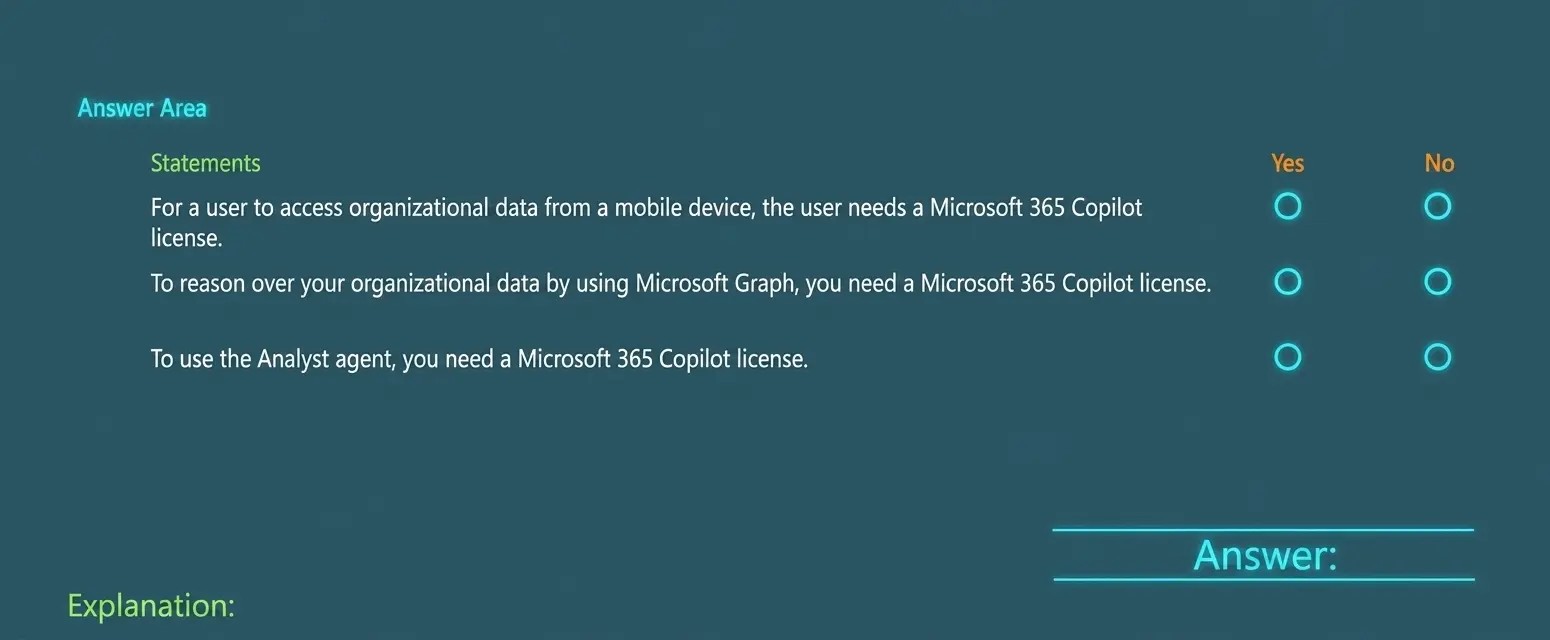
Drag & DropHOTSPOT For each of the following statements, select Yes if the statement is true.
Otherwise, select No. NOTE: Each correct selection is worth one point
Show Answer & Explanation Hide Answer & Explanation
Correct Answer
Explanation
For a user to access organizational data from a mobile device, the user needs a Microsoft 365 Copilot license. No To reason over your organizational data by using Microsoft Graph, you need a Microsoft 365 Copilot license. Yes To use the Analyst agent, you need a Microsoft 365 Copilot license. Yes Top of Form Bottom of Form The key distinction here is between Copilot Chat capabilities available with a standard Microsoft 365 subscription and the full Microsoft 365 Copilot add-on that enables richer, in-context experiences grounded in organizational data. Mobile access to organizational data does not inherently require a Microsoft 365 Copilot license. Microsoft’s Microsoft 365 Copilot app (and related mobile experiences) can provide Copilot Chat for work/school accounts with a Microsoft 365 license, so simply accessing organizational content on a mobile device is not the same as having the paid Copilot add-on. The statement claims a Copilot license is required just to access org data from mobile, which is too broad—there are mobile Microsoft 365 apps that access org data without the Copilot add-on. Reasoning over organizational data via Microsoft Graph is a core value proposition of Microsoft 365 Copilot. Microsoft documents explain that Microsoft 365 Copilot connects LLMs to your organization’s content and context through Microsoft Graph and generates responses “anchored” in organizational dat a. That deeper integration is tied to the Microsoft 365 Copilot experience (an add-on license). Analyst is a “reasoning agent” within Microsoft 365 Copilot and Microsoft states that users with a Microsoft 365 Copilot license can use Analyst (with defined usage limits). Therefore, the Analyst agent requires the Microsoft 365 Copilot license.
-
Question 6
Single answerYour company plans to use generative AI to help build a website that will showcase various existing products. Which capability best describes a benefit of using generative AI for this project? Select the BEST answer.
-
Option A:Correct
translating product descriptions into a different language
-
Option B:Correct
analyzing product sales to identify patterns and trends
-
Option C:Correct
designing a new product based on customer requirements
-
Option D:Correct
Show Answer & Explanation Hide Answer & Explanation
Correct Answer: D
Explanation
For a product showcase website, the highest-impact, most directly relevant generative AI benefit is content creation at scale—producing consistent, high-quality product copy quickly. Option D matches a core generative AI capability: turning structured inputs (specifications such as dimensions, materials, features, compatibility, and use cases) into natural-language descriptions that are readable, persuasive, and formatted for web publishing. This accelerates catalog onboarding, reduces manual writing effort, and helps maintain a consistent tone and structure across thousands of SKUs.
Option A (translation) is also something generative AI can do, but it is a narrower, secondary capability compared to the primary website need: generating product copy from specs. Option B is predictive/analytical AI rather than generative content creation. Option C is plausible in ideation, but the scenario is about showcasing existing products, not inventing new ones. Therefore, D is the best answer because it aligns directly with the project’s core workflow (product specs → publishable descriptions) and delivers measurable business value through speed, consistency, and reduced content production costs.
-
-
Question 7
Single answerWhich business requirement most closely relates to grounding a generative AI model?
-
Option A:Correct
supporting multiple languages
-
Option B:Correct
measuring the number of user interactions per day
-
Option C:Correct
enabling users to interact by using natural language queries
-
Option D:Correct
Show Answer & Explanation Hide Answer & Explanation
Correct Answer: D
Explanation
Grounding in generative AI means ensuring model outputs are based on trusted, relevant information sources rather than only on the model’s general training data. In a business context, grounding is about aligning responses with verified enterprise knowledge (policies, product documentation, internal procedures, approved FAQs, etc.) so the system is more accurate, consistent, and defensible. That is exactly what option D describes: “ensuring that verified company data sources are used for response generation.”
In Microsoft AI solution patterns, grounding is commonly achieved using retrieval-augmented generation (RAG). With RAG, the system retrieves relevant passages from approved company repositories (for example, indexed documents or knowledge bases) and supplies them as context to the model during response generation. This reduces hallucinations, improves factual correctness, and makes answers more relevant to the organization’s reality—critical when AI is used for customer support, employee helpdesks, compliance guidance, or executive reporting.
The other options do not directly address grounding. A relates to localization/multilingual capability, B is a usage/telemetry metric, and C is an interaction method (natural language interface). They can all be important requirements, but none of them ensure outputs are anchored to verified company data—the core purpose of grounding.
-
-
Question 8
Single answerWhat is considered a best practice when forming an AI adoption team in an enterprise environment?
-
Option A:Correct
Include representatives from legal, leadership, and business units to align AI initiatives with organizational priorities.
-
Option B:Correct
Include primarily IT and project management staff initially to streamline deployment, adding governance and compliance roles later.
-
Option C:Correct
Include only data scientists and engineers at first to validate technical feasibility, then add other stakeholders later.
-
Option D:Correct
Include procurement and vendor management specialists early to evaluate AI tools, involving business teams once a platform is selected.
Show Answer & Explanation Hide Answer & Explanation
Correct Answer: A
Explanation
Enterprise AI adoption succeeds when it is cross-functional from the start. Option A is best practice because AI impacts legal risk, privacy, security, compliance, workforce processes, and business strategy—not just technology. Including leadership ensures alignment to priorities and funding; including business units ensures use cases and success metrics are real; including legal/compliance ensures responsible AI and regulatory obligations are addressed early. This prevents rework and reduces the chance of deploying solutions that are misaligned with policy or unacceptable risk.
Options B and C delay governance and business alignment, which often leads to “build first, govern later” failure modes—solutions that work technically but cannot be approved or scaled due to privacy/security gaps or unclear accountability. Option D over-optimizes for vendor selection without ensuring the organization has defined responsible AI requirements, target use cases, and operating model. Procurement is important, but it is not the primary driver of a successful adoption team. The most sustainable approach is a representative adoption team that integrates business, technical, and governance stakeholders from day one.
-
-
Question 9
Single answerWhich statement accurately describes the difference between a pretrained generative AI model and a fine-tuned generative AI model?
-
Option A:Correct
A pretrained model requires labeled data, while a fine-tuned model does not.
-
Option B:Correct
A pretrained model is faster to train than a fine-tuned model because the pretrained model uses fewer parameters.
-
Option C:Correct
A pretrained model is trained on broad datasets, while a fine-tuned model is adapted to perform well on a narrower, domain-specific dataset.
-
Option D:Correct
Show Answer & Explanation Hide Answer & Explanation
Correct Answer: C
Explanation
A pretrained generative AI model is trained initially on a large, broad, and diverse dataset so it learns general language (or multimodal) patterns and capabilities. Fine-tuning then takes that pretrained base and performs additional training on a smaller, task- or domain-specific dataset to specialize behavior—improving performance for a particular use case, tone, style, or domain knowledge representation. That is exactly what option C states, making it the correct answer.
Option A is incorrect because both pretraining and fine-tuning may use labeled or unlabeled data depending on the technique; the distinction is not “labeled vs. unlabeled.” Option B is incorrect because a pretrained model is not “faster to train” due to fewer parameters; pretraining is typically the most compute-intensive phase precisely because it’s done at large scale, while fine-tuning is smaller but still trains the same model architecture. Option D is reversed: the pretrained model is the general-purpose foundation, while the fine-tuned model is the specialized variant for a specific task or dataset.
-
-
Question 10
Single answerYou need to help analysts investigate incidents across endpoint, identity, cloud, and security operations data. The analysts must summarize alerts, identify affected resources, and review recommended next steps by using natural language.
What should you use?
-
Option A:Correct
Microsoft Security Copilot
-
Option B:Correct
Microsoft 365 Copilot
-
Option C:Correct
Azure Document Intelligence
-
Option D:Correct
Show Answer & Explanation Hide Answer & Explanation
Correct Answer: A
Explanation
The correct answer is A. Microsoft Security Copilot. The requirement is clearly a security operations scenario: analysts must investigate incidents across endpoint, identity, cloud, and security operations data. Microsoft Security Copilot is designed for security teams and supports natural-language investigation, alert summarization, incident context, affected-resource identification, and recommended response actions. Microsoft 365 Copilot is focused on productivity tasks such as drafting, summarizing, and analyzing content in Microsoft 365 apps. Azure Document Intelligence extracts structured information from documents such as forms and invoices. Microsoft Copilot Studio is used to build and customize agents for business workflows. Because the scenario centers on security incident investigation and response guidance, Microsoft Security Copilot is the correct solution.
-