
| Exam Code | AI-300 |
| Exam Name | Operationalizing Machine Learning and Generative AI Solutions (beta) |
| Vendor | Microsoft |
| Total Questions | 116 |
| Last Updated | 15-Nov, 2026 |
- Latest & Verified Questions
- Detailed Explanations
- Regular Updates
- Full-Length Practice Tests
- Boost Your Exam Confidence
PDF Study Materials
Downloadable guides and resources
Practice Tests
Full-length tests with real exam experience
Progress Tracking
Monitor your performance and improvement
Study Anywhere
Access on desktop, tablet, and mobile
Free AI-300 Practice Questions
Explore 11 free practice questions for the Microsoft AI-300 exam and review the answers and explanations to support your preparation.
-
Question 1
Single answerYou manage an Azure Machine learning workspace. You develop a machine learning model. You must deploy the model to use a low-priority VM with a pricing discount. You need to deploy the model. Which compute target should you use?
-
Option A:Correct
Azure Container Instances (ACI)
-
Option B:Correct
Azure Machine Learning compute clusters
-
Option C:Correct
Local deployment
-
Option D:Correct
Azure Kubernetes Service (AKS)
Show Answer & Explanation Hide Answer & Explanation
Correct Answer: B
Explanation
-
-
Question 2
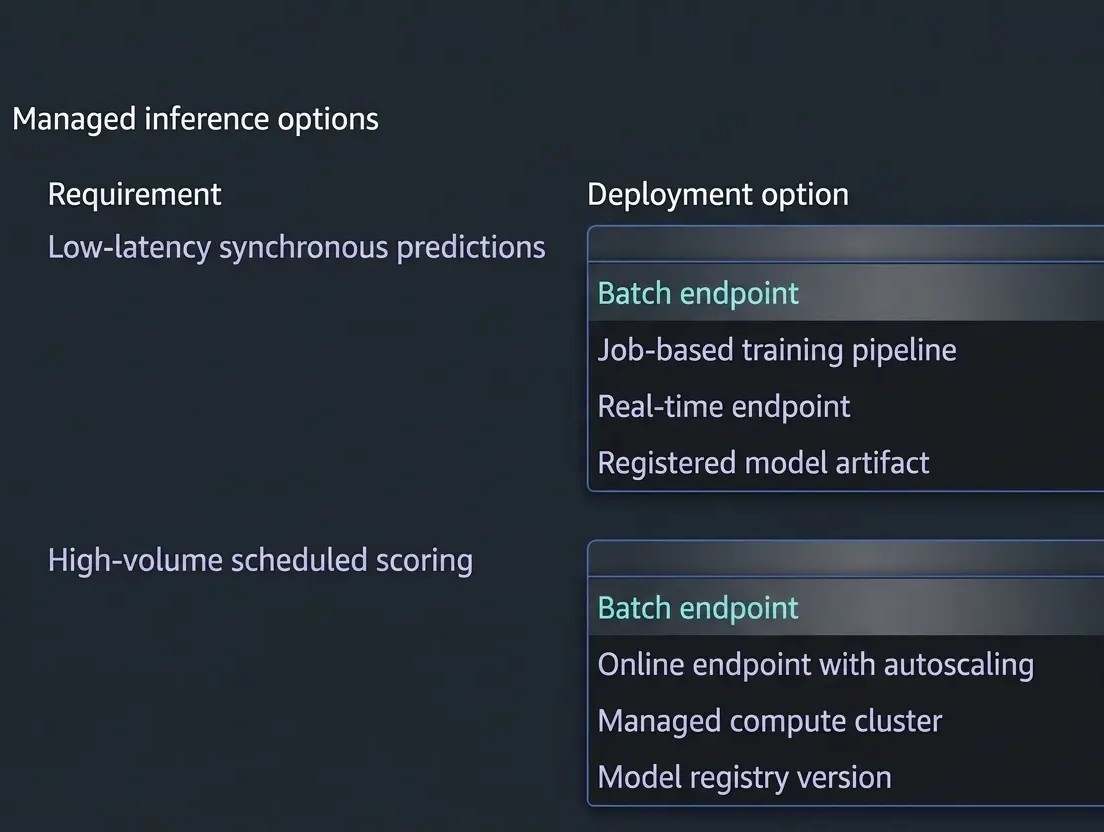
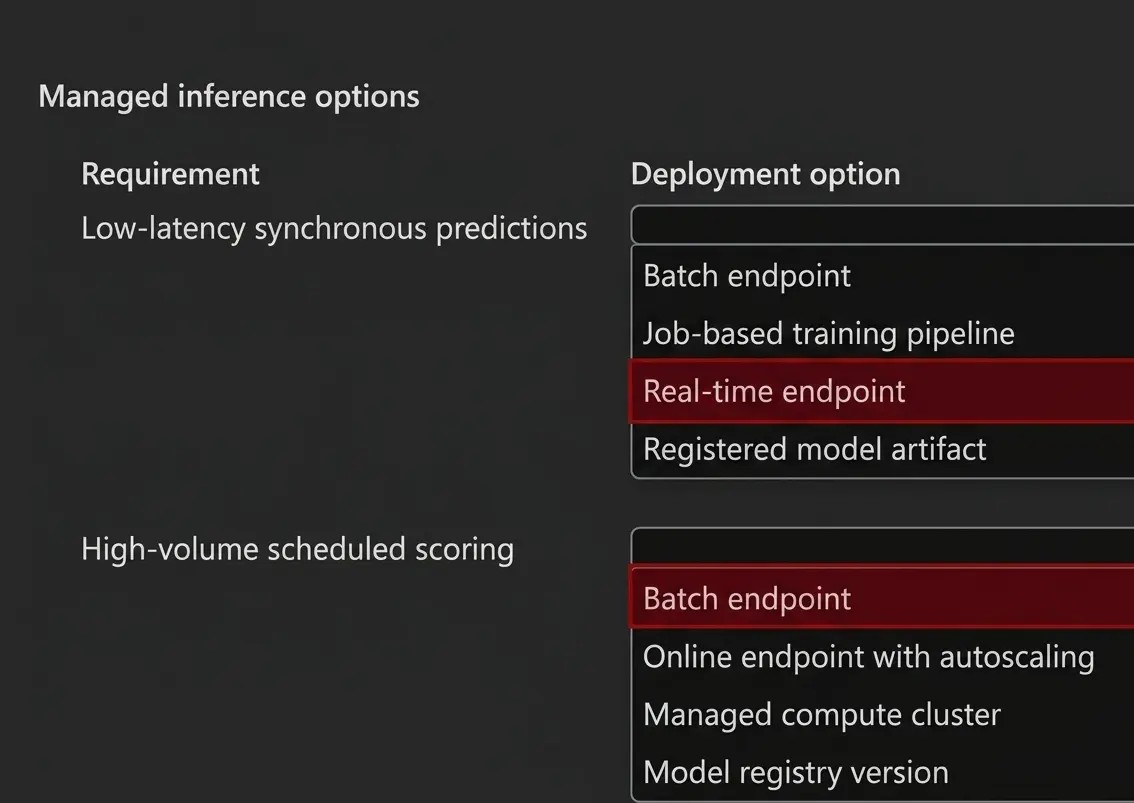
Drag & DropA team trains an MLflow model that scores customer churn risk. The model will be consumed by different downstream systems. One system requests predictions synchronously during customer interactions. Another system submits files containing millions of records for scheduled scoring. You need to deploy the model by using managed inference options that match each usage pattern. Which option should you use for each usage pattern? To answer, select the appropriate options in the answer area. NOTE: Each correct selection is worth one point.
Show Answer & Explanation Hide Answer & Explanation
Correct Answer
Explanation
-
Question 3
Single answerYou need to recommend an experiment-tracking strategy that ensures consistent experiment results. What should you recommend?
-
Option A:Correct
Azure Machine Learning job output logs
-
Option B:Correct
MLflow experiment tracking
-
Option C:Correct
Application Insights logs
-
Option D:Correct
Azure Monitor alerts
Show Answer & Explanation Hide Answer & Explanation
Correct Answer: B
Explanation
-
-
Question 4
Single answerYou need to isolate training workloads while remaining cost-aware to address Fabrikam Inc.’s issues, constraints, and technical requirements. What should you implement?
-
Option A:Correct
Training jobs that run on a single shared compute cluster
-
Option B:Correct
Fixed-size compute cluster
-
Option C:Correct
Dedicated compute clusters per experiment
-
Option D:Correct
Managed compute targets with autoscaling
Show Answer & Explanation Hide Answer & Explanation
Correct Answer: D
Explanation
-
-
Question 5
Single answerYou need to standardize how Fabrikam Inc. manages machine learning assets. Which action should you perform first?
-
Option A:Correct
Register assets in the Azure Machine Learning registry
-
Option B:Correct
Create a shared Azure Machine Learning workspace.
-
Option C:Correct
Deploy a managed online endpoint.
-
Option D:Correct
Create a new Microsoft Foundry project.
Show Answer & Explanation Hide Answer & Explanation
Correct Answer: B
Explanation
A shared Azure Machine Learning workspace is the foundational step for standardizing how machine learning assets are managed across an organization. The workspace acts as a central environment where datasets, models, environments, pipelines, and compute resources are created, organized, and governed. By establishing a shared workspace first, Fabrikam Inc. ensures that all teams are working within a consistent structure, which enables proper collaboration, access control, and lifecycle management of ML assets.
Once the workspace is in place, other capabilities—such as registering assets in an Azure Machine Learning registry or deploying managed online endpoints—can be built on top of it. Without a standardized workspace, asset management would remain fragmented and inconsistent, making governance and reuse difficult. -
-
Question 6
Single answerYou use the Azure Machine Learning SDK v2 for Python and notebooks to train a model. You use Python code to create a compute target an environment and a training script You need to prepare information to submit a training job. Which class should you use?
-
Option A:Correct
command
-
Option B:Correct
MLClient
-
Option C:Correct
EndpointConncction
-
Option D:Correct
BuildContext
Show Answer & Explanation Hide Answer & Explanation
Correct Answer: A
-
-
Question 7
Single answerYou need to isolate training workloads while remaining cost-aware to address Fabrikam Inc.’s issues, constraints, and technical requirements.
What should you implement?
-
Option A:Correct
Training jobs that run on a single shared compute cluster
-
Option B:Correct
Fixed-size compute cluster
-
Option C:Correct
Dedicated compute clusters per experiment
-
Option D:Correct
Show Answer & Explanation Hide Answer & Explanation
Correct Answer: D
Explanation
Imagine a hospital analytics firm with data scientists who kick off dozens of training jobs throughout the week. During peak hours, five jobs compete for the same GPU cluster and fail or queue for hours. On quiet nights, that cluster sits completely idle, burning money. Managed compute targets with autoscaling solve both problems: the cluster scales out automatically when multiple jobs arrive simultaneously and scales back to zero when idle. Option A (single shared cluster) is exactly the resource-contention problem Fabrikam already has. Option B (fixed-size cluster) wastes money during off-peak hours. Option C (dedicated per-experiment clusters) eliminates contention but is prohibitively expensive for a cost-conscious healthcare firm. Autoscaling managed compute is the cloud-native answer to variable workload demand.
Microsoft Learn Reference Topic: Azure Machine Learning compute targets – Configure autoscale for compute clusters
-
-
Question 8
Single answerYou need to standardize how Fabrikam Inc. manages machine learning assets.
Which action should you perform first?
-
Option A:Correct
Register assets in the Azure Machine Learning registry.
-
Option B:Correct
Create a shared Azure Machine Learning workspace.
-
Option C:Correct
Deploy a managed online endpoint.
-
Option D:Correct
Show Answer & Explanation Hide Answer & Explanation
Correct Answer: B
Explanation
In Azure Machine Learning, a workspace is the top-level resource that acts as a centralized hub for every ML activity. It stores experiments, pipelines, datasets, models, environments, and compute targets all in one place. Before you can register assets or deploy endpoints, the workspace itself must exist and be shared across the team. Fabrikam ' s core challenge is inconsistent experiment tracking, ad-hoc versioning, and no standardized deployment path — all symptoms of the absence of a single, governed workspace. Option A (registering assets) is a subsequent action only possible after the workspace exists. Option C (online endpoint) is a deployment concern, not an asset-management foundation. Option D (Foundry project) is appropriate for generative AI workloads, not for the traditional ML pipeline standardization described here. The workspace is the prerequisite that makes every other governance action possible.
Microsoft Learn Reference Topic: Azure Machine Learning workspaces – Microsoft Learn: Manage Azure Machine Learning workspaces
-
-
Question 9
True / FalseNote: This question is part of a series of questions that present the same scenario. Each question in the series contains a unique solution that might meet the stated goals. Some question sets might have more than one correct solution, while others might not have a correct solution.
After you answer a question in this section, you will NOT be able to return to it. As a result, these questions will not appear on the review screen.
You work in Microsoft Foundry with a prompt flow.
You must manually evaluate prompts and compare results across prompt variants.
You need to capture the inputs, outputs, token usage, and latencies for each flow run for the evaluation.
Solution: Create prompt variants and compare their outputs in the Evaluation experience.
Does the solution meet the goal?
-
Option A: TrueCorrect
-
Option B: FalseCorrect
Show Answer & Explanation Hide Answer & Explanation
Correct Answer: B
Explanation
The Evaluation experience in Microsoft Foundry ' s prompt flow editor shows aggregate quality scores across prompt variants — which variant produces more coherent answers, which scores higher on groundedness. However, it does not expose per-run raw telemetry: individual token counts per call, per-request latency in milliseconds, or the exact input-output pairs for each execution. The Evaluation experience is designed for comparative quality scoring, not for detailed operational telemetry. To capture inputs, outputs, token usage, and latencies at the granular run level, Tracing must be enabled in Microsoft Foundry. Tracing records each LLM call as a structured span with timing, token consumption, and the complete input-output payload — a fundamentally different view than evaluation scores that directly satisfies all four capture requirements.
Microsoft Learn Reference Topic: Trace and debug prompt flows in Microsoft Foundry – Tracing vs. Evaluation
-
-
Question 10
Single answerYou use an Azure Machine Learning workspace.
You must monitor cost at the endpoint and deployment level.
You have a trained model that must be deployed as an online endpoint. Users must authenticate by using Microsoft Entra ID.
What should you do?
-
Option A:Correct
Deploy the model lo Azure Kubernetes Service (AKS). During deployment, set the token_auth_mode parameter of the target configuration object to true.
-
Option B:Correct
Deploy the model to a managed online endpoint. During deployment, set the token_auth_mode parameter of the target configuration object to true.
-
Option C:Correct
Deploy the model to Azure Kubernetes Service (AKS). During deployment, set the auth.mode parameter to configure the authentication type.
-
Option D:Correct
Deploy the model to a managed online endpoint. During deployment, set the auth_mode parameter to configure the authentication type.
Show Answer & Explanation Hide Answer & Explanation
Correct Answer: D
-
-
Question 11
Single answerYou need to recommend an experiment-tracking strategy that ensures consistent experiment results.
What should you recommend?
-
Option A:Correct
Azure Machine Learning job output logs
-
Option B:Correct
MLflow experiment tracking
-
Option C:Correct
Application Insights logs
-
Option D:Correct
Show Answer & Explanation Hide Answer & Explanation
Correct Answer: D
Explanation
MLflow is the industry-standard open-source platform for experiment tracking, and Azure Machine Learning has first-class native integration with it. When you use MLflow within an Azure ML job, parameters, metrics, and artifacts are automatically logged to the run history of the AML workspace, making every run reproducible and comparable. Option A (AML job output logs) only captures console output and lacks structured parameter and metric logging. Option C (Application Insights logs) is designed for application-level telemetry, not ML experiment metadata. Option D (Azure Monitor alerts) is a reactive notification tool, not a tracking system. MLflow ' s autologging capability means that for common frameworks such as scikit-learn, XGBoost, and PyTorch, parameters and metrics are captured without a single line of custom code, directly answering Fabrikam ' s requirement for consistent experiment tracking.
Microsoft Learn Reference Topic: Track ML experiments with MLflow – Azure Machine Learning MLflow integration
-